3                                                                                                Brainwave Connections                                                                                 Fall 2005

Text Box: It is common to regard the alpha rhythm as an idling rhythm, one that occurs when no active work is done.  This is taken in contrast to the faster rhythms such as beta and gamma, which are considered to represent a “processing” phase.  Thus, the concentration/relaxation cycle is taken to be that characterized by phases of relaxation (alpha) and phases of concentration (beta).  The use of alpha enhance protocols, and the use of “squash” protocols, both appeal to the notion of this cycle, and seek to produce either a preponderance of one phase, or the facility to alternate flexibly between phases.
Based on laboratory research, it is now evident that the alpha mechanism is not simply a pacing or timekeeping mechanism (Shaw, 2003).  Rather, it participates in memory scanning and related mental processing in a profound manner.  Contrary to the concept that thinking occurs when alpha is absent, it is more correct to say that alpha activity persists during essentially all mental processing, but that it takes on a character of desynchronization during certain tasks
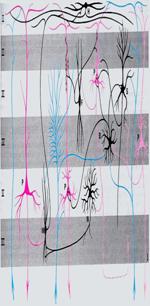
The mechanism that produces synchronous alpha also operates at the single cell level, as the relaxation of inhibitory fibers whose primary function is to throttle the activity of the active (pyramidal) cells.  These are primarily thalamocortical (collateral afferent) and cortico-cortical projections, that hold back the pyramidal cells from firing, despite the considerable excitatory input they may see.  These receive information including sensory, body awareness, muscle feedback, and related signals, impinging on a range of primary sensory, Text Box: secondary sensory, and somatosensory areas.
Timing is what is controlled.  At any given time, pyramidal cells are likely to be firing or not firing, as a function of their local population dynamics.  But when the firing begins to synchronize, that alone is significant enough that a mere 1% of the cortical cells can determine over 96% of the EEG (Shaw 2003, page 19).
Alpha is always there at a cellular level.  However, the memory scanning that it represents is modulated at a unit-cell level, so that the relative timing of neighboring cells is variable.  Desynchronization and synchronization is what is modulated.  Thus, the pyramidal cell populations can slide in and out of phase with each other, providing a wide range of surface amplitudes, which we see as EEG.
The highly synchronized (high alpha) state is a low entropy state.  The more synchronization can be achieved, the lower the momentary entropy of the system. Entropy can be sequestered in time as well as in space.  The time-space analog of a highly organized, crystalline material is the synchronous alpha activity in the brain.  Rather than simply organizing matter in a structured fashion, the brain organizes events in both time and space, in a structured fashion
This provides a rationale for connectivity-based training.  By considering the various connectivity pathways in the brain and training them explicitly for flexibility, it is possible to use a wide range of protocols toward a primary goal, without resorting to a simple model of “remediating what is too large or too small”.
Text Box: This also provides a rationale or downtraining, in the context of connectivity.  The effect of downtraining a rhythm is to exercise the inhibitory influences, in such a way as to induce them to produce maximal desynchrony, hence independence.  When viewed as an essential component in the momentary switching of mental tasks, this flexibility can be expected to lead to enhanced mental fluidity and effectiveness.
Alpha training thus provides functional relaxation, not systemic relaxation.  That is, the mechanism, which performs at a cellular level, specifically modulates localized internal inhibitory influences, resulting in an increase in synchronized, aggregate activity of active mental processing elements. Although these elements are not necessarily engaged in tasks at the time of the EEG training, the resulting learning provides flexibility of activation, which is a useful learned skill.


Text Box: A Relaxation/Activation model of Alpha
Text Box: Alpha activity persists during essentially all mental processing, but it takes on a character of desynchronization during certain tasks

Article by:

Tom Collura

Text Box: Reference:

Shaw, J.C., (2003) The Brain’s Alpha Rhythms and the Mind, Amsterdam: Elsevier Press