2                                                                                                Brainwave Connections                                                                        Summer 2005

Text Box: During technical and practical neurofeedback training, we are often asked about thresholding.  People want to know how to choose thresholds, where to set the target percentages, when to update thresholds, and so on.  Sometimes there is an expectation that there is a “best” or “only” way to work.  In reality, use of thresholding is an art as well as a science, due to the range and variety of issues encountered, as well as individual differences in trainees and trainers.
According to Webster, a threshold is a “starting point”.  In neurofeedback, the thresholds marks the points in time when rewards may be forthcoming, thus when learning may begin.  When using autothresholding, the computer is programmed to find and apply the best thresholds, so that the trainee experiences the desired rate of reward.  When the computed thresholds are used, this is called “updating” them.  One key questions is, exactly how often should thresholds be updated?
There is a wide range of opinion and practice in this area.  We present here the dominant philosophies, along with mention of significant practitioners who have researched and used them.  These are recommendations, not rules.
Set the thresholds once and try to avoid changing them (Lubar, Brownback).  This point of view is based on the concept that the trainee is best served by seeing improvements (or reductions) in the feedback as the EEG changes, and that the changes should provide an accurate reflection.  It may further propose that changing thresholds can frustrate or thwart learning by masking EEG improvements, as thresholds are Text Box: adjusted to adapt to them.  
Generally, thresholds are determined by an assessment process, that may be extensive.  The trainee may be given one or more trial sessions, and the results of early training may be monitored, to ensure that the values chosen are robust.  Multiple thresholds may be used.  Once chosen, thresholds are held constant as much as possible, to provide a constant “bar” for the trainee to work with.
Set the thresholds at the beginning of each session and try to leave them alone (Ayers).  This point of view recognizes that day-to-day changes may occur, and that the exact EEG readings for a particular session need not match those from previous (or subsequent) sessions.  Part of the feedback to the client includes reporting the levels that are attained, and the thresholds that are used.  Thus, the daily threshold levels become part of the feedback, and address the issues of motivation reward.
The basic approach is to inform the trainee of their levels for that day, and then see if they can “make your usual 1000 points” with the new targets.  Thus, the feedback includes a sense of accomplishment.
Update the thresholds periodically, to adapt to short-term changes in the EEG (Othmer, Soutar).  This approach is based largely on learning theory and operant conditioning research, which indicates that there is an optimal level of reward contingency for learning to occur.  Typical time intervals for readjusting thresholds vary from 1 minute to 10 minutes, with 2 to 5 minutes being most common.  It is also common to introduce a pause of Text Box: 10 or 20 seconds, to allow the trainee to rest, and review the training results so far.
Update the thresholds continually, to emphasize training of variability  (Brown & Brown).  This approach is based on the concepts of dynamical systems, in which the primary goal is to provide the brain with information regarding short-term changes in brain state, to allow adaptive learning to occur.  The principles of operant conditioning are not brought into play, as this is not viewed in a traditional learning model.  The point of view here is that the brain will learn its own limits and parameters, and thus develop improved self-regulation.
In summary, we see that a full range of possibilities exists for the use of automatically adjusted training targets.  The methods chosen will depend on the needs of the trainee, as well as the preferences and opinions of the trainer.
Text Box: Thresholding—When and How

Autothresholding


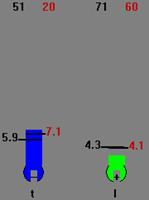
In the example above, autothresholding is being used to set threshold levels for theta and lobeta training.  The current theta threshold (shown in black) is 5.9 microvolts, and the current percent time over threshold is 51%.  The target percentage is 20% (shown in red).  Therefore, the autothresholding algorithm has chosen a new (higher) threshold of 7.1 microvolts.  The question is, when should this new threshold be applied (“Updated”)? When the value of 7.1 is used for the current threshold, the trainee will experience a change (increase) in the reward rate, as the training becomes”easier”.

Autothresholding thus impacts the trainee’s experience, expectations, and motivation.

Article by:

Thomas F. Collura, Ph.D., P.E., BCN

Dr. Collura is a biomedical engineer, neurophysiologist, and neurofeedback systems developer.