4                                                                                                Brainwave Connections                                                                        Summer 2005

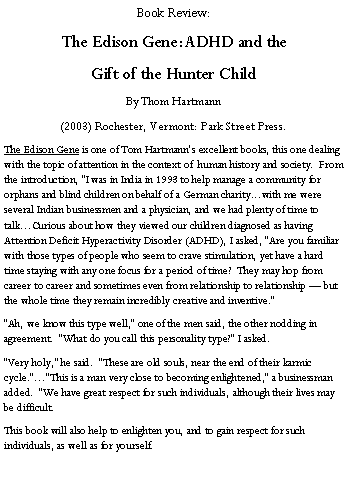
Text Box: Book Review:  
The Edison Gene: ADHD and the 
Gift of the Hunter Child
By Thom Hartmann
(2003) Rochester, Vermont: Park Street Press.
The Edison Gene is one of Tom Hartmann’s excellent books, this one dealing with the topic of attention in the context of  human history and society.  From the introduction, “I was in India in 1993 to help manage a community for orphans and blind children on behalf of a German charity...with me were several Indian businessmen and a physician, and we had plenty of time to talk...Curious about how they viewed our children diagnosed as having Attention Deficit Hyperactivity Disorder (ADHD), I asked, “Are you familiar with those types of people who seem to crave stimulation, yet have a hard time staying with any one focus for a period of time?  They may hop from career to career and sometimes even from relationship to relationship — but the whole time they remain incredibly creative and inventive.”  
“Ah, we know this type well,” one of the men said, the other nodding in agreement.  “What do you call this personality type?” I asked.
“Very holy,” he said.  “These are old souls, near the end of their karmic cycle.”…”This is a man very close to becoming enlightened,” a businessman added.  “We have great respect for such individuals, although their lives may be difficult.
This book will also help to enlighten you, and to gain respect for such individuals, as well as for yourself.
Text Box: Published by: Stress Therapy Solutions Inc.
Publishing Editor: Terri Mrklas Collura
Subscription: $50/year;  Provided without charge to all Active Affiliates of BrainMaster Technologies, Inc.
Website: www.stresstherapysolutions.com
Publication:  minimum of 4 issues/year

Editorial Guidelines:  Articles 250 to 2000 words, PC format ASCII (.txt) Rich Text (.rtf) or Microsoft Word1 (.doc).  Submit via email to stsinc@pantek.com or send disk or hardcopy to StressTherapy Solutions Inc., 3401 Enterprise Parkway, Suite 340, Beachwood OH  44122.  
Phone:  216-766-5707 or 800-447-8052  FAX: 216-439-3015

The publisher reserves the right to accept, reject, and/or edit any article or advertisement, in whole or in part, and assumes no responsibility for validity; nor for mistakes of omission, typographical errors, or photo placement errors, in whole or in part, in advertisements or articles.  Brainwave Connections and StressTherapy Solutions Inc.and its staff and/or consultants neither endorse, support, nor assume any liability whatsoever for any product or service advertised or mentioned within.  


Entire contents copyright © 2005 StressTherapy Solutions Inc.  All rights reserved.  Reproduction in whole or in part 
without written permission from the publisher is prohibited.

1 “Microsoft Word” is a trademark of Microsoft Corporation
Text Box: Brainwave Connections
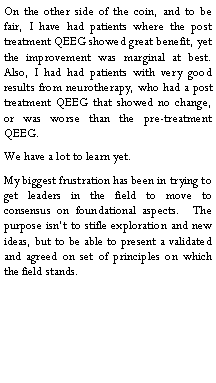
Text Box: On the other side of the coin, and to be fair, I have had patients where the post treatment QEEG showed great benefit, yet the improvement was marginal at best. Also, I had had patients with very good results from neurotherapy, who had a post treatment QEEG that showed no change, or was worse than the pre-treatment QEEG.
We have a lot to learn yet.
My biggest frustration has been in trying to get leaders in the field to move to consensus on foundational aspects.  The purpose isn’t to stifle exploration and new ideas, but to be able to present a validated and agreed on set of principles on which the field stands. 
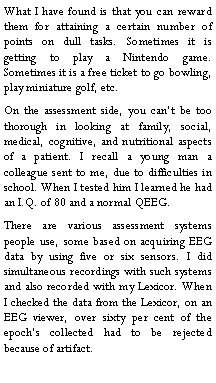
Text Box: What I have found is that you can reward them for attaining a certain number of points on dull tasks. Sometimes it is getting to play a Nintendo game. Sometimes it is a free ticket to go bowling, play miniature golf, etc.
On the assessment side, you can’t be too thorough in looking at family, social, medical, cognitive, and nutritional aspects of a patient. I recall a young man a colleague sent to me, due to difficulties in school. When I tested him I learned he had an I.Q. of 80 and a normal QEEG.
There are various assessment systems people use, some based on acquiring EEG data by using five or six sensors. I did simultaneous recordings with such systems and also recorded with my Lexicor. When I checked the data from the Lexicor, on an EEG viewer, over sixty per cent of the epoch’s collected had to be rejected because of artifact.
Text Box: Things Noticed Along the Way (continued from page 3)

Hal Schaus, M.S., DAPA,  is in private practice in Northeast Ohio.  He can be reached by telephone at: 330 836-7223 or by email at:   schaustennis@aol.com

Text Box: While not exhaustive, this would include an adequate knowledge of basic neuroscience, knowledge of relevant physics and electronics and knowing what EEG normal and abnormal states are and how they present themselves.

“Within you there is a stillness and a sanctuary to which you can retreat at any time and be yourself”


-Hermann Hesse, Siddhartha