4                                                                                                Brainwave Connections                                                                          Winter 2005

Text Box: Book Review:  
Getting Started with Neurofeedback
By John Demos, W.W. Norton & Co., 2005
Getting Started with Neurofeedback is an unusually thorough, concise, informative, and practical book on the practice of neurofeedback.  This is one of the most succinct introductions to the field that I have seen, and it also includes a wealth of practical information.  Ultimately, Demos provides sufficient background and applications information to allow anyone with sufficient qualifications to begin working in this area.  It would be an excellent text resource for a formal training program, as well.
Covering a wide range of approaches and philosophies, Getting Started with Neurofeedback is unique in that it does not espouse one approach.  Rather, it puts many approaches in perspective, and allows the reader to make intelligent decisions regarding when, how, and in what manner one wants to apply neurofeedback therapy.  It includes basic neurophysiology and anatomy, the value of brain maps and mini-assessments, and practical considerations for formulating treatment plans, configuring and using equipment, and interpreting results.  Really a “must have” for anyone in the field of neurofeedback, considering entering the field, or any seriously curious student who wants to understand this emerging and changing area.
Review by: Thomas F. Collura, Ph.D., P.E., BCN
Text Box: Published by: Stress Therapy Solutions, Inc.
Publishing Editor: Terri Mrklas Collura
Subscription: $50/year;  Provided to all Active Affiliates of BrainMaster Technologies, Inc.
Website: www.stresstherapysolutions.com
Publication:  minimum of 4 issues/year

Editorial Guidelines:  Articles 250 to 2000 words, PC format ASCII or Word.  Submit via email to info@stresstherapysolutions.com or send disk or hardcopy to Stress Therapy Solutions, 25825 Science Park #100, Beachwood OH  44122.  FAX: 216-439-3015.  Phone: 216-766-5707.

The publisher reserves the right to accept, reject, and/or edit any article or advertisement, in whole or in part, and assumes no responsibility for validity; nor for mistakes of omission, typographical errors, or photo placement errors, in whole or in part, in advertisements or articles.  Brainwave Connections neither endorses, supports, or assumes any liability whatsoever for any product or service advertised or mentioned within.  

Entire contents copyright © 2005 Stress Therapy Solutions, Inc.  All rights reserved.  Reproduction in whole or in part without written permission from the publisher is Text Box: Brainwave Connections
Text Box: run 8 people at a time, and trainees sign up on time-share basis to use the equipment, which is technically on lease to them.  Trainees and family members are taught how to use the equipment, and are supervised during their labwork to ensure quality and results.
Dr. Boone is now combining neurofeedback with audio tapes, to provide custom-recorded tapes to each trainee that they can take home for further work.  This allows home users to replicate the sound environment from the lab, providing “classical” conditioning to reinforce the neurofeedback therapy.
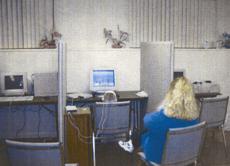
As a result of his work, Dr. Boone is kept very busy, even in this town of less than 30,000 people.  For better or worse, his is the office where people go when “problem” cases arise, that no one else seems to be able to manage.  If other practitioners can learn and adopt from his Text Box: One of the benefits of working in the field of neurofeedback is discovering the many and varied ways in which practitioners approach their work.  One shining example is Dr. Tom Boone, who has converted a former Picayune, Mississippi newspaper office into a clinic, walk-in lab, and  healing center for the community.  Dr. Boone remodeled the 7,000 square foot facility to provide 15 professional offices plus an 8-station walk-in laboratory equipped for EEG, HEG, and auditory and photic stimulation.
While the focus of Dr. Boone’s work is psychotherapy, he employs a host of adjunct methods including hypnotherapy, counseling, EEG and HEG neurofeedback, photic stimulation, and the use of audio cassette tapes.
The walk-in center employs a model that is somewhere between conventional clinical neurofeedback and home training.  It can Text Box: models, we will surely see growth in the field, and benefits for greater numbers of those seeking help.
For more information, contact:
Tom Boone Ph.D. and Associates, 214 N. Curran Ave., Picayune, MI  39466.  601 799-4403.
Text Box: Site Review—Tom Boone, Ph.D. and Associates

Mother and son “doing” neurofeedback at Dr. Tom Boone’s walk-in clinic