1                                                                                                Brainwave Connections                                                                          Winter 2006

Text Box: The Amish Connection
Text Box: When is Full?
Text Box: As a child, I once sat in the kitchen and pondered a large bag of sugar  on the table.  I pictured the millions of grains in the bag, and wondered how it might be filled, one grain at a time.  Starting with an empty bag, adding one grain at a time, when would the bag be full?  The first grain certainly would not fill it.  Not the second grain.  We could continue in this manner until the bag was, say, half full.  Then the next grain would not make it full.  Nonetheless, the time would surely come when Text Box: the bag would be “mostly” full.  But then the next grain would not fill it.  When exactly would it be full?  This did not seem trivial to me, but was something worth thinking about.  As it turns out, it has taken me 50 years to reach some kind of an answer.  The key lies in habit, in intention, and in continuity of process.  The bag would be “as good as” full when the decision was  made that each grain would be there in turn, without fail.  No particular one of these miniscule grains could fill a bag.  But the once the Text Box: process was in place, and the habit, the intention, were established, the eventual filling of the bag would become a certainty.  The bag would then at least be “virtually” full.  So now, I wonder, how does this relate to neurofeedback? 

Text Box: Winter 2006
Text Box: Volume 2, Issue 1

Brainwave Connections

Text Box: In this issue:
The Amish Connection
When is Full?
“But what do I do?”: Instructions to Neurofeedback Trainees
Invited Book Review:  Getting Started with Neurofeedback by John N. Demos 

Site Review: Brownback, Mason and Associates, P.C.

Dedicated to communication and education in the emerging fields of neurofeedback, mental fitness, neuromeditation, and brain modification

Text Box: In coming issues:
Book Reviews, Site Reviews, and personal commentaries
Text Box: We live in Northeast Ohio.  In addition to plenty of lakes and streams, horse farms, llama and alpaca farms, apple orchards, metroparks and industrial centers, we also share our area with a considerable number of Amish, Mennonites, and other like-minded religious communities.  The sight of horse-drawn carriages, small farms, and rolling hills dotted with curtainless white houses is common.
I recently interactedwith a family counselor who also practices therapy within
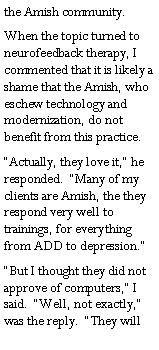
Text Box: the Amish community.
When the topic turned to neurofeedback therapy, I commented that it is likely a shame that the Amish, who eschew technology and modernization, do not benefit from this practice.
“Actually, they love it,” he responded.  “Many of my clients are Amish, the they respond very well to trainings, for everything from ADD to depression.”
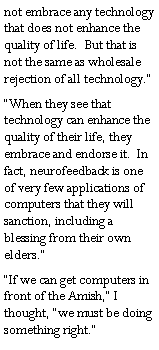
“But I thought they did not  approve of computers,” I  said.  “Well, not exactly,” was the reply.  “They will
Text Box: not embrace any technology that does not enhance the quality of life.  But that is not the same as wholesale rejection of all technology.”  
“When they see that technology can enhance the quality of their life, they embrace and endorse it.  In fact, neurofeedback is one of very few applications of computers that they will sanction, including a blessing from their own elders.”
“If we can get computers in front of the Amish,” I thought, “we must be doing something right.”